

Shoulder arthroscopy is a minimally invasive procedure that allows the surgeon to see directly inside the shoulder joint, confirm the diagnosis, and repair the damage – all through incisions smaller than one centimetre.
It is performed by Panagiotis Papadopoulos MD, MSc, orthopaedic surgeon specialising in shoulder and knee surgery, at private practice in Glyfada and at the HYGEIA Hospital in Marousi.
Contents
What Is Shoulder Arthroscopy?
Arthroscopy – often called keyhole surgery – uses a thin camera inserted into the joint through a small portal. The image is transmitted in high resolution and magnified up to twenty times, so structures that would be difficult to assess through an open incision can be examined in detail.
This makes the procedure both diagnostic and therapeutic. The surgeon confirms what the MRI suggested, sees what it could not show, and treats the problem in the same session.
The structures involved
The shoulder is the most mobile joint in the human body, and for that reason also the least inherently stable. The socket (glenoid) is relatively flat, and stability depends almost entirely on the soft tissues surrounding it:
- Rotator cuff – four tendons (supraspinatus, infraspinatus, subscapularis, teres minor) responsible for stability and rotation
- Labrum – a rim of cartilage deepening the socket
- Articular cartilage – the smooth surface allowing the bones to glide
- Acromion – the bony projection above the joint
- Subacromial bursa – the sac that cushions movement between the acromion and the cuff
Almost all of these can be reached and repaired arthroscopically.
How Is Shoulder Arthroscopy Performed?
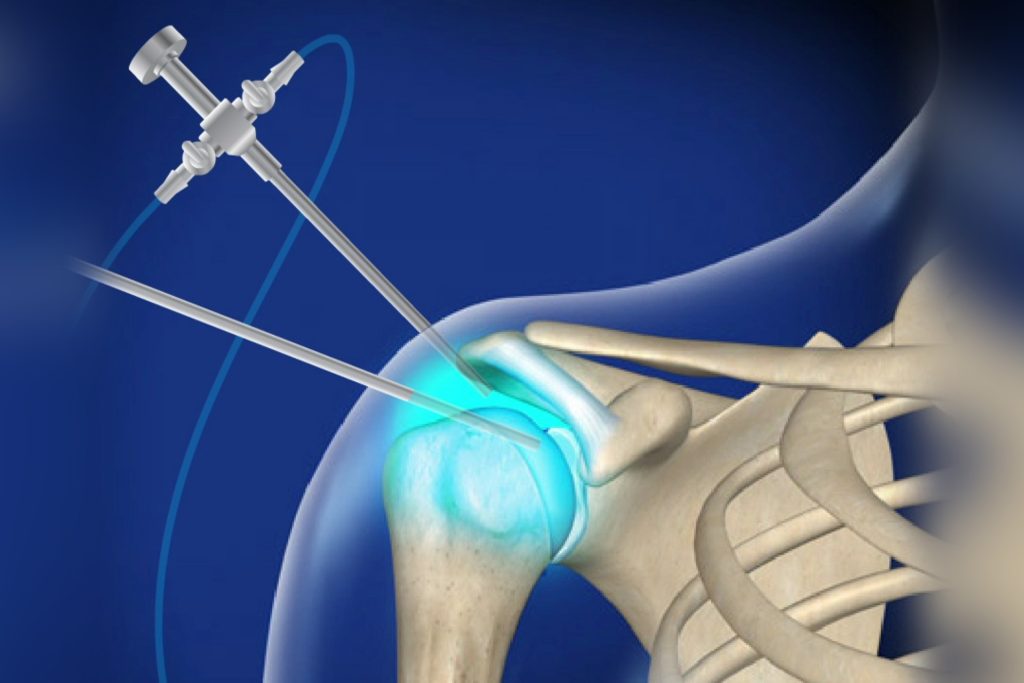
1. Anaesthesia and positioning. The procedure is performed under general anaesthesia. The patient is positioned to give the surgeon full access to the joint.
2. The first portal. A single opening of less than one centimetre is made, through which the arthroscope — a fine camera — is introduced into the joint.
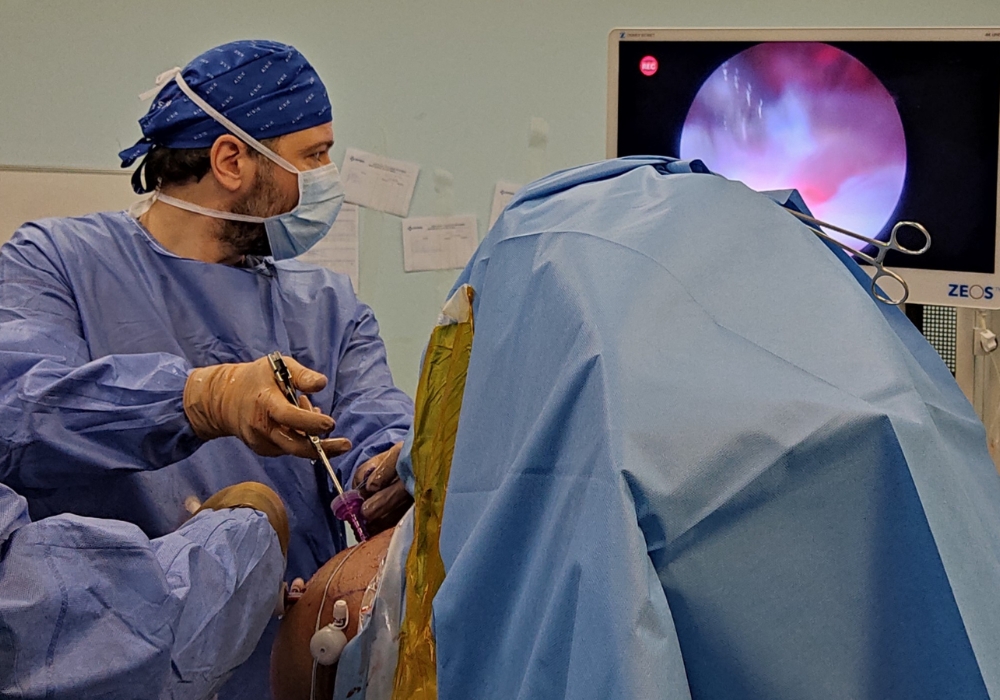
3. Diagnostic inspection. The joint is inspected systematically in high-resolution, magnified view. This step frequently refines the pre-operative diagnosis: an MRI shows a great deal, but not everything, and the definitive assessment is made here.
4. Working portals. Two to three further openings of similar size are made around the shoulder to introduce the instruments needed for the repair.
5. The repair. What follows depends on the condition being treated — reattaching a torn tendon, releasing a contracted capsule, repairing a labral tear, removing inflamed tissue. The individual procedures are described in the section below.
6. Closure. Each portal is closed with a single suture, removed eight to ten days later.
7. Duration and discharge. Most shoulder arthroscopies take one to one and a half hours. Patients are usually discharged three to four hours after the procedure, on the same day.

Are There Incisions or Scars?
No. Shoulder arthroscopy avoids the large incisions of open surgery entirely. The three or four portals are under a centimetre each and heal to marks that are barely visible. Beyond the cosmetic result, this matters clinically: less soft tissue is disturbed, so post-operative pain is significantly lower and mobilisation begins sooner.
When Is Shoulder Arthroscopy Recommended?
Surgery is not the first answer to most shoulder problems. Arthroscopy is generally considered when:
- symptoms persist despite an adequate course of physiotherapy and conservative treatment
- there is a traumatic tear in an active patient, where early repair gives the better outcome
- the shoulder is unstable and dislocates repeatedly
- imaging findings correspond to the clinical picture — a tear seen on MRI is only relevant if it explains the patient’s symptoms
Before the decision. Assessment includes a clinical examination of range of motion, stability and strength, X-rays to evaluate the bone, and an MRI scan to assess tendons, ligaments and soft tissue. Once surgery is planned, routine pre-operative work-up follows: blood tests, chest X-ray, ECG and cardiology clearance. Admission is on the day of the procedure.
Frozen Shoulder (Adhesive Capsulitis)
Frozen shoulder – known medically as adhesive capsulitis – is a progressive stiffening of the joint capsule causing pain and severe loss of movement. It is largely self-limiting, and the great majority of patients recover with physiotherapy, anti-inflammatory treatment and injections.
Arthroscopy is reserved for resistant cases: shoulders that remain stiff and painful after months of appropriate conservative treatment. The procedure is an arthroscopic capsular release, in which the thickened, contracted capsule is divided to restore movement. Structured physiotherapy immediately afterwards is essential — the release creates the opportunity, rehabilitation delivers the result.
Rotator Cuff Tear

A rotator cuff tear may be traumatic – a fall, a heavy lift, a sudden pull – or degenerative, developing gradually with age. Not every tear requires surgery. Partial and degenerative tears in older, less demanding patients frequently do well with physiotherapy.
Repair is indicated for full-thickness tears, acute traumatic tears, and tears causing weakness that does not recover, particularly in active patients. Arthroscopic rotator cuff repair reattaches the torn tendon to the bone using anchors placed at its original insertion. Recovery is longer than for other shoulder arthroscopies, because the tendon must heal to bone before strengthening can begin.
Shoulder Dislocation and Instability
After a first dislocation, most shoulders are treated without surgery – reduction, a period of immobilisation, then rehabilitation. The problem is recurrence: the younger and more active the patient at the time of the first dislocation, the higher the chance the shoulder will dislocate again.
For recurrent instability, arthroscopic Bankart repair reattaches the detached labrum and tightens the stretched capsule, restoring the anatomical restraint the shoulder has lost. Where repeated dislocations have caused significant bone loss from the socket, a soft tissue repair is not sufficient and a bone-block procedure such as Latarjet is the appropriate operation – this is assessed before surgery and discussed with the patient.
SLAP Tear
Typical of overhead and throwing athletes, and of falls onto an outstretched arm, causing deep shoulder pain and loss of power above shoulder height. Conservative treatment comes first; when symptoms persist, the arthroscopic options are repair of the superior labrum or, in older patients where repair is less predictable, biceps tenodesis – releasing the tendon and securing it lower down, which reliably relieves pain.
Shoulder Impingement Syndrome
Pain from compression of the rotator cuff tendons and bursa in the narrow space beneath the acromion, felt on lifting the arm to shoulder height and above. Physiotherapy targeting scapular control and cuff strength is the mainstay of treatment. Arthroscopic subacromial decompression – removing inflamed bursa and reshaping the undersurface of the acromion – is considered in selected cases where a well-conducted rehabilitation programme has not resolved symptoms.
Labral Tear
Most often seen alongside instability, causing pain, catching, and a sense of the shoulder giving way. Repaired arthroscopically by reattaching the torn rim to the socket with small anchors.
Biceps Tendon Problems
Pain at the front of the shoulder, usually accompanying rotator cuff pathology rather than occurring in isolation. When injection and physiotherapy fail, the tendon is released and re-secured (tenodesis) or simply released (tenotomy) — both reliable for pain relief.
AC Joint Injuries
Separation of the acromioclavicular joint follows a direct fall onto the shoulder. Lower-grade injuries settle without surgery; high-grade separations, where the ligaments are completely disrupted and the deformity is significant, are treated surgically to restore alignment.
Also treated arthroscopically
Calcific tendinitis · acromioclavicular joint arthritis · loose bodies within the joint · biceps tendon rupture · selected fractures of the shoulder and glenoid
Arthroscopic vs Open Shoulder Surgery
For the conditions above, arthroscopy has largely replaced open surgery, and for good reason:
- No large incisions and minimal disruption of healthy tissue
- Substantially less post-operative pain, controlled with ordinary analgesics
- High diagnostic accuracy through magnified direct visualisation
- Lower complication rate
- Same-day discharge in most cases
- Earlier mobilisation and faster return to work and daily activity
- A cosmetic result without disfiguring scars
It is equally important to be clear about where arthroscopy is not the right answer. Massive rotator cuff tears that are no longer repairable may require a tendon transfer or reverse shoulder replacement. Instability with significant glenoid bone loss is better served by a Latarjet procedure. Advanced arthritis of the joint is treated by shoulder replacement, not arthroscopy. Recommending the right operation matters more than recommending the least invasive one.
Anaesthesia: What to Expect
Patients often ask whether shoulder arthroscopy can be done under local anaesthetic. Strictly speaking it cannot – the two options are a nerve block or general anaesthesia.
General anaesthesia is preferred here, as it is in most major shoulder surgery centres. It allows the surgeon to work with greater precision and comfort, and it spares the patient the disconcerting experience of waking with an arm that is completely numb and immobile for hours afterwards. Complications of modern general anaesthesia are very rare. Nerve blocks carry a somewhat higher rate of complications, principally nerve injury.
You will be asleep throughout, and you will wake with your arm working normally and your pain controlled.
Recovery After Shoulder Arthroscopy
The first days. Discharge is three to four hours after surgery. A simple sling is fitted, and you will be given clear instructions on how to use the arm in the first days. Pain after arthroscopic surgery is limited and short-lived, and is managed with ordinary painkillers. The sutures are removed after eight to ten days.
Rehabilitation. A physiotherapy protocol is designed for each patient according to the procedure performed, and follows three phases:
Phase 1 — Protection (weeks 1–3). The priority is settling pain and swelling. The sling is worn, gentle passive movement is performed under the guidance of a physiotherapist, and active movement of the shoulder is avoided.
Phase 2 — Restoring movement (weeks 4–8). Exercises become active-assisted, with range of motion increased progressively. Most patients return to light work and normal daily activities during this phase.
Phase 3 — Strengthening (weeks 9–12 and beyond). Resisted active exercise restores muscle strength. Return to sport is gradual and supervised.
How long overall. This depends on what was done. After a simple procedure — removal of loose bodies, for example — recovery may be complete in three to four weeks. After a rotator cuff repair, where the tendon must heal to bone, full recovery can take four to six months. Your surgeon will give you a realistic timeframe for your specific procedure before you go into theatre.
Book your appointment on 698 05 06 555
Contact usRisks and Complications
Shoulder arthroscopy is a safe and effective procedure, but like any operation it carries some risk. In experienced hands, complications are uncommon and generally mild, affecting up to around five percent of patients.
- Infection. Rare and treatable. Managed with antibiotics and, if required, arthroscopic washout of the joint.
- Technical failure. The most common cause of a poor result, and the reason shoulder arthroscopy should be performed by a surgeon who specialises in shoulder surgery rather than one who performs it occasionally.
- Post-operative stiffness. Usually without an identifiable cause, and responsive to a properly structured rehabilitation programme.
- Bleeding. Rare, given the minimally invasive nature of the procedure.
- Thrombophlebitis. Very rare after shoulder arthroscopy; early mobilisation reduces the risk further.
Cost of Shoulder Arthroscopy in Greece
The total cost of shoulder arthroscopy is made up of three components:
- Hospital costs — theatre time, room, nursing care, medication, and the implants and consumables used, which vary with the procedure and the extent of the repair
- Surgical fees — the surgeon, assistants and anaesthetist
- Implants and materials — anchors and other devices, depending on what the repair requires
If you hold private or international health insurance, the procedure is notified to your insurer and, once pre-approval is granted, covered according to the terms of your policy. We can advise on what your insurer will typically require.
If you are paying privately, you will receive a clear breakdown of all three components before you commit to surgery. There are no costs presented after the event.
Patients travelling from abroad should factor in the pre-operative work-up and the post-operative follow-up period as well as the surgery itself. We will set out the full picture — including how long you should plan to remain in Athens — at the consultation stage.
Contact us for a personalised estimate for your procedure.
About Your Surgeon
Panagiotis Papadopoulos MD, MSc - Orthopaedic Surgeon, Sports Medicine
Deputy Director of the 3rd Orthopaedic Clinic at HYGEIA Hospital, with subspecialty training in shoulder and knee surgery, sports injuries and minimally invasive treatment. He consults at his private practice in Glyfada and at HYGEIA in Marousi.




Shoulder Arthroscopy in Glyfada and Marousi
Whether you live in Athens, are working here on assignment, or are travelling to Greece for treatment, consultations and follow-up are conducted in English throughout.
Private Practice — Glyfada 4 Leoforos Dimarchou Angelou Metaxa, 3rd floor, Glyfada 166 75, Athens
3rd Orthopaedic Clinic, HYGEIA Hospital — Marousi 5 Erythrou Stavrou, 5th floor, Marousi 151 23, Athens
Telephone: 210 89 49 727 Mobile: 6980 506 555 Email: info@arthrojoint.gr
If you are contacting us from outside Greece, send your MRI report and a short description of your symptoms by email and we will advise on the next step.
Frequently Asked Questions
How long does shoulder arthroscopy take?
Most procedures take between one and one and a half hours, depending on what is being treated.
Will I stay in hospital overnight?
Usually not. Most patients are discharged three to four hours after surgery.
Will I be awake during the operation?
No. The procedure is performed under general anaesthesia.
How long will I need to wear a sling?
This depends on the procedure. A capsular release requires only brief protection, while a rotator cuff repair requires considerably longer. Your surgeon will tell you before surgery.
When can I drive again?
Once you are out of the sling and have enough control of the arm to manage the wheel safely — typically several weeks, and earlier after simpler procedures than after a cuff repair.
When can I go back to work?
Desk-based work is usually possible within a few weeks. Physical work involving lifting or overhead activity takes considerably longer.
Do I definitely need physiotherapy?
Yes. The surgery creates the conditions for recovery; rehabilitation is what produces the result. This is not an optional extra.
Will the shoulder be as good as it was?
For most patients and most conditions, the aim is full, pain-free movement and a return to normal activity. Your surgeon will be honest with you about the realistic expectation for your specific case.
