

Knee arthroscopy is a minimally invasive procedure that allows the surgeon to see inside the knee joint, diagnose the problem and repair it in the same operation, through two or three openings a few millimetres across.
It is performed by Panagiotis Papadopoulos MD, MSc, orthopaedic surgeon specialising in knee and shoulder surgery and sports injuries, at his private practice in Glyfada and at the HYGEIA Hospital in Marousi.
Contents
What Is Knee Arthroscopy?
A camera is introduced into the joint through a small portal, giving a magnified, high-resolution view of the interior of the knee. Fine instruments passed through one or two further portals are used to locate the damage and repair it. The joint capsule is filled with saline during the procedure, opening up the space so that everything can be seen clearly.
Arthroscopy has replaced the open knee operations that were the only option in previous decades. Its advantages are consistent:
- Minimal disruption of healthy tissue and markedly less post-operative pain
- Magnified direct visualisation, giving diagnostic accuracy that imaging cannot match
- Faster mobilisation and return to daily life
- Same-day discharge in almost all cases
- No disfiguring scars
- Very low infection rates
- Multiple problems can be treated in a single operation

How Is Knee Arthroscopy Performed?
The procedure is carried out in hospital. Anaesthesia may be regional, general, or a combination of the two – the anaesthetic team will discuss this with you and recommend the safest option for you, taking your general health into account.
Two to three openings a few millimetres across are made at the front of the knee. The camera is introduced through the first, and the joint is inspected systematically – menisci, cruciate ligaments, cartilage surfaces and the tracking of the patella. Instruments are then passed through the remaining portals to carry out the repair.
Duration varies with the procedure, from around half an hour for a simple meniscectomy to an hour and a half for an ACL reconstruction.
Afterwards you will spend a short period in the recovery ward and go home the same day with written instructions. If you would prefer to stay overnight, that can be arranged without difficulty. You will be given a pair of crutches to help with walking in the first days – how long you need them depends on what was done.
When Is Knee Arthroscopy Recommended?
Most knee problems are treated without surgery. Arthroscopy is considered when symptoms persist despite physiotherapy, when there is a mechanical problem the knee cannot resolve on its own – locking, catching, or a fragment moving inside the joint – when the knee is unstable and gives way, and when the imaging findings match the clinical picture. All the available options are weighed with you before a decision is made.
Pre-operative work-up includes blood tests, chest X-ray, ECG and cardiology clearance, together with knee imaging – X-ray and MRI. You will inform the anaesthetist of any medication you take and receive fasting instructions. Admission is on the day of surgery.
A pre-operative visit to the physiotherapist is also recommended, to go through the rehabilitation programme in advance and learn to use crutches before you need them rather than afterwards.

Meniscus Tear and Meniscus Surgery
Meniscal tears occur through injury – typically a twisting movement with the foot planted, common in football and skiing – or through gradual wear with age. Not every tear requires surgery, and physiotherapy is often the first step.
Where surgery is needed, meniscal repair is preferred whenever possible because preserving the meniscus helps protect the joint in the long term. Recovery involves protected weight-bearing for around six weeks. Partial meniscectomy removes only the unstable torn fragment, allowing a quicker recovery with crutches for five to seven days.
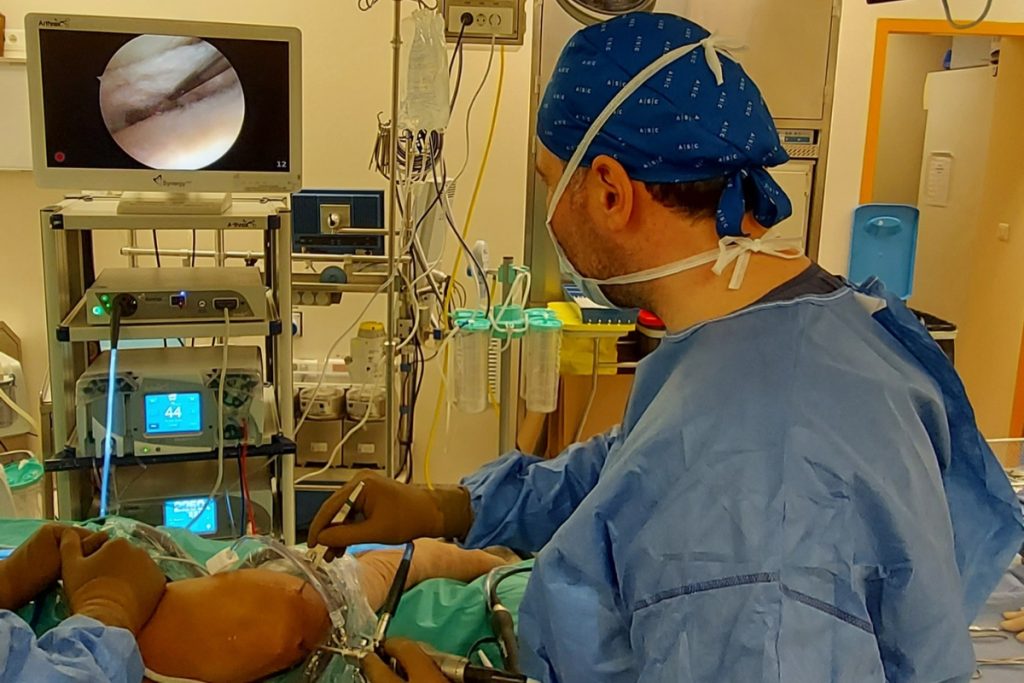

(Photos from Mr Papadopoulos’ knee arthroscopy surgery for the repair of a meniscus tear)
ACL Tear and ACL Reconstruction
The anterior cruciate ligament (ACL) provides forward and rotational stability to the knee. It typically tears during a non-contact twisting injury, often accompanied by an audible pop, immediate swelling and a feeling that the knee is unstable.
A torn ACL does not heal by itself. Reconstruction is recommended for patients returning to pivoting sports or whose knee repeatedly gives way during everyday activities. The ligament is replaced with a graft taken from the hamstring, patellar or quadriceps tendon, secured to the femur and tibia. The operation takes around 90 minutes, with crutches usually required for about two weeks.
All-Inside ACL Reconstruction
This minimally invasive technique uses sockets rather than full bone tunnels, preserving more bone, requiring smaller incisions and often reducing post-operative pain. Suitability is assessed on an individual basis.
Cartilage Damage and Chondromalacia Patella
Chondromalacia patella is deterioration of the cartilage behind the kneecap, causing pain at the front of the knee that is typically worse on stairs, squatting or after prolonged sitting. Most patients improve with physiotherapy aimed at restoring muscle balance and patellar tracking.
Symptomatic focal cartilage defects can be treated arthroscopically by smoothing the damaged surface and removing unstable fragments. In selected severe lesions, chondrocyte transplantation may regenerate the cartilage. These procedures treat localised defects rather than generalised arthritis.
Patellar Instability
Patellar dislocation occurs when the kneecap moves out of its groove during a twisting injury. A first dislocation is usually treated without surgery through reduction, protection and rehabilitation. Recurrent instability is treated surgically by correcting the underlying cause, while displaced cartilage fragments can be repaired or removed arthroscopically.
Other Conditions Treated Arthroscopically
PCL tear. The posterior cruciate ligament is injured less commonly than the ACL, usually following a direct blow to the front of a bent knee. Many isolated PCL injuries are treated without surgery, while reconstruction is reserved for severe injuries, persistent instability or combined ligament damage.
Loose bodies. Free fragments of cartilage or bone that cause locking or catching are removed arthroscopically, often with excellent results.
Synovectomy. Removal of inflamed synovial tissue where it is responsible for ongoing pain and swelling.
Arthroscopy is also used to treat selected knee cysts, perform joint lavage in cases of infection, and manage certain tibial plateau fractures.
Knee Arthroscopy and Arthritis
Arthroscopy does not treat arthritis.
When cartilage loss is widespread and the joint surface has worn away, arthroscopy cannot restore the damaged cartilage or relieve arthritic pain. In early arthritis, however, it can still help if there is a specific mechanical problem, such as a loose fragment or unstable flap causing locking.
Once knee arthritis becomes established, treatment is either conservative for as long as symptoms remain manageable or, when it no longer provides sufficient relief, knee replacement.
Recovery After Knee Arthroscopy
Recovery varies more after knee arthroscopy than after almost any other operation, because the procedures grouped under the name are so different. Recovery also depends on the type of damage treated, your general health, any other conditions present, and consistency with rehabilitation.
The first two weeks. Rest with the leg elevated, ice several times a day to reduce swelling, and crutches, bearing weight as pain allows. Dressings are changed every two to three days and sutures removed at ten to fourteen days. The portals heal within eight to ten days and initial swelling settles over two to three weeks.
Pain is managed with simple analgesics – paracetamol or a mild anti-inflammatory. Patients do not experience significant or unmanageable pain after this operation.
Crutches, by procedure:
- Partial meniscectomy – five to seven days
- Meniscal repair – protected weight-bearing for six weeks
- ACL or PCL reconstruction – approximately two weeks
Returning to work. Most patients return within ten to fifteen days, provided the job does not put heavy demands on the leg. Desk work is usually possible within a week.
Physiotherapy
Physiotherapy follows an individual programme in three phases:
Phase 1 (Weeks 1–2): Pain and swelling control with ice, elevation and gentle exercises, while gradually restoring mobility.
Phase 2 (Weeks 3–6): Recovery of range of motion and progressive strengthening, with return to light daily activities.
Phase 3 (Week 7 onwards): Strength, balance and functional training, followed by a gradual return to sport.
Recovery time depends on the procedure performed. Simple arthroscopic procedures usually require 3–4 weeks, whereas recovery after ACL reconstruction typically takes 4–6 months.
Return to sport ranges from around one month after a partial meniscectomy to approximately six months after ACL reconstruction, with swimming and light jogging often introduced earlier where appropriate.
Risks and Complications
Knee arthroscopy is an extremely safe operation, with a complication rate below one percent.
Some blood within the joint is normal in mild form in the first days. Swelling and stiffness immediately after surgery are expected and improve with rehabilitation. Deep vein thrombosis is very rare, and early mobilisation reduces the risk further. Infection occurs in fewer than one in a thousand cases and is treated with antibiotics or arthroscopic washout. Iatrogenic cartilage damage is very rare in specialist hands, and complications of anaesthesia are rare and fully treatable.
Book your appointment on 698 05 06 555
Contact usCost of Knee Arthroscopy in Greece
The cost depends on the procedure performed, any specialised implants or fixation devices required, and the hospital, surgical team and anaesthetist fees.
With private or international insurance, the procedure is covered according to your policy once pre-authorisation has been obtained. If you are paying privately, you will receive a full cost breakdown before surgery.
Travelling from abroad?
We will advise you on the pre-operative assessment, follow-up requirements and, where necessary, how rehabilitation can continue with a physiotherapist in your home country.
Contact us for a personalised estimate.
Knee Arthroscopy in Glyfada and Marousi
Panagiotis Papadopoulos MD, MSc - Orthopaedic Surgeon, Sports Medicine.
Deputy Director of the 3rd Orthopaedic Clinic at HYGEIA Hospital, specialising in knee and shoulder surgery, sports injuries and minimally invasive techniques.
Consultations and follow-up are provided in English for both local and international patients.
Private Practice – Glyfada
4 Leoforos Dimarchou Angelou Metaxa, 3rd Floor
Glyfada 166 75, Athens
HYGEIA Hospital – 3rd Orthopaedic Clinic, Marousi
5 Erythrou Stavrou, 5th Floor
Marousi 151 23, Athens
Telephone: +30 210 8949727
Mobile: +30 6980 506555
Email: info@arthrojoint.gr

